• Log in
  • Cart (0)
  • Checkout
  • Shop

    COLLECTIONS  

    Back to School Essentials
    ACV Tonics
    Books + Zines
    Elixirs + Bitters
    Herbal Teas
    Small Batch + Seasonal
    Gift Cards

    ACTIONS  

    Digestive Support
    Immune Support
    Inflammatory Response Support
    Respiratory Support
    Rest + Sleep Support
  • Learn

    RECIPES  

    Energy Sangria Mocktail
    Digestive Delight: a piña colada inspired beverage
    The Maine Forest Fizz
    The Knockout
    See all...

    HERB PROFILES  

    Milky Oats: Why Fresh is Everything
    Chamomile: Benefits, Growing + Harvesting, and Herbal Honey
    Lemon Balm: A Cooling, Uplifting Herb for Mood, Digestion & Everyday Plant Medicine
    See all...

    WELLNESS  

    From Seed to Bottle: What Vertically Integrated Herbal Medicine Means
    Summer Solstice on the Farm: Herbs, Harvests and the Longest Day
    Everything Is Connected: How Gut Health, Immunity, and Herbal Medicine Work Together
    Fire Cider: A Folk Remedy, A Legal Battle, + A Story of Resilience
    See all...
  • About Us

    ABOUT US  

    Our Story
    The Farm
    Stockists
    Meet Kathi + the Team
    Join Our Team
    Resources + Businesses We Support

    CONNECT WITH US  

    Join Our Newsletter
    Instagram
    Facebook
    TikTok
    Pinterest
    Send Us A Message
  • Wholesale
  • Shop
  • COLLECTIONS  

    Back to School Essentials
    ACV Tonics
    Books + Zines
    Elixirs + Bitters
    Herbal Teas
    Small Batch + Seasonal
    Gift Cards

    ACTIONS  

    Digestive Support
    Immune Support
    Inflammatory Response Support
    Respiratory Support
    Rest + Sleep Support
  • Learn
  • RECIPES  

    Energy Sangria Mocktail
    Digestive Delight: a piña colada inspired beverage
    The Maine Forest Fizz
    The Knockout
    See all...

    HERB PROFILES  

    Milky Oats: Why Fresh is Everything
    Chamomile: Benefits, Growing + Harvesting, and Herbal Honey
    Lemon Balm: A Cooling, Uplifting Herb for Mood, Digestion & Everyday Plant Medicine
    See all...

    WELLNESS  

    From Seed to Bottle: What Vertically Integrated Herbal Medicine Means
    Summer Solstice on the Farm: Herbs, Harvests and the Longest Day
    Everything Is Connected: How Gut Health, Immunity, and Herbal Medicine Work Together
    Fire Cider: A Folk Remedy, A Legal Battle, + A Story of Resilience
    See all...
  • About Us
  • ABOUT US  

    Our Story
    The Farm
    Stockists
    Meet Kathi + the Team
    Join Our Team
    Resources + Businesses We Support

    CONNECT WITH US  

    Join Our Newsletter
    Instagram
    Facebook
    TikTok
    Pinterest
    Send Us A Message
  • Wholesale
Herb Profiles

Milky Oats: Why Fresh Is Everything

by Katheryn Langelier August 12, 2026

Milky Oats: Why Fresh Is Everything

Fresh Milky Oats: Why Fresh Is Everything

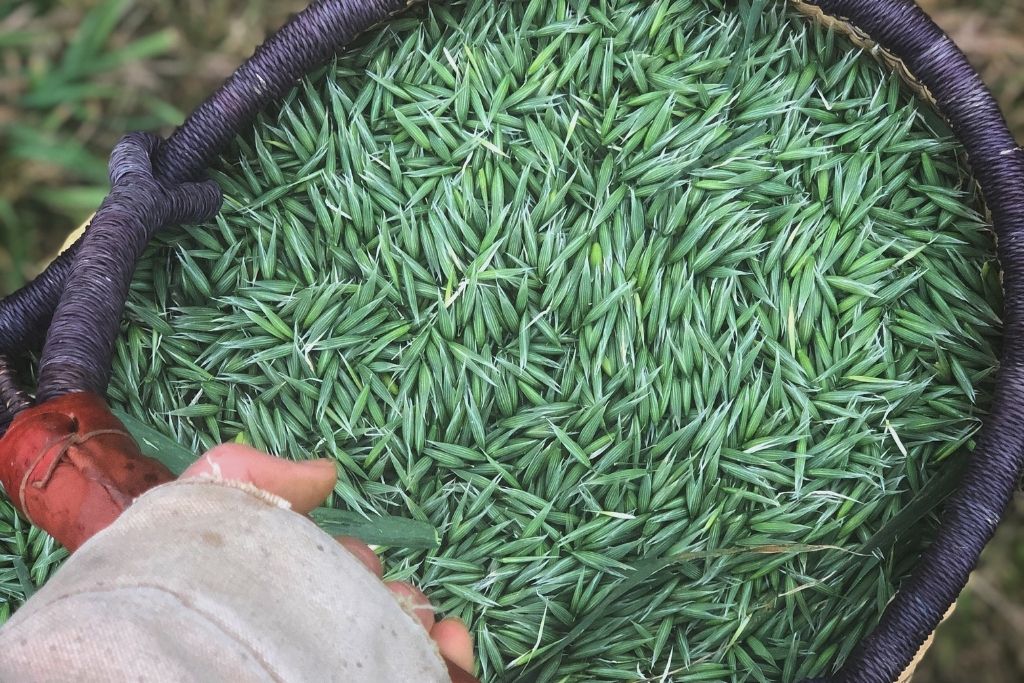
There’s a short window in the life cycle of an oat plant when the tops are right where I want them for harvesting.

The seed heads are green and fat and full of a milky white substance. When I pinch one between my fingers, a thick, creamy milk oozes out. That’s what I’m looking for.
If I miss this stage by just a few days, that milky substance hardens into the groat, which will become delicious oatmeal. And although it’s deeply nourishing at that stage, it’s no longer the trophorestorative medicine that I'm looking for with the fresh.

Here on the farm, oats play multiple roles. I start planting them in the early spring both as a crop to harvest, and I sow them throughout the growing season as a cover crop. This plant isn’t just nourishing to us; it's also nourishing to the soil, bringing in nutrients when used as a green manure. Once I see the oats go from looking like lovely lush grass to growing their tops, I start paying closer attention. I head out to the fields regularly to check on them, pinch them, and see where they are in their growth stage.

When I start consistently seeing that white, milky cream ooze out, I know they’re ready. They need to be harvested and tinctured that same day.

Why Milky Oats?

Most people know Avena sativa, or more commonly known as oats or oatmeal, as breakfast.

What is less known about your morning oats is that the very same plant, caught at exactly the right moment, is one of the finest trophorestoratives we have for a worn-out nervous system.

Trophorestoratives are foods and plants that work slowly and cumulatively. You take them for weeks and months versus just a day here or there. Tropho is a root word from Greek that means nourishment, and it describes a specific kind of plant, one that actually feeds and rebuilds a depleted body system rather than just managing the symptoms on top of it.

What trophorestoratives do is support the restoration of the tissue’s own ability to do its job. This is one of the main reasons we work with fresh milky oats at Herbal Revolution.

Your Nervous System Is Doing So Much

Our bodies are amazing, and our nervous system is a beautiful thing.

It keeps us breathing, moving, and experiencing all of our senses. The brain and spinal cord make up the central nervous system. Branching out from there, the peripheral nerves reach into our organs, muscles, and skin, gathering information and sending it back in.
Running right alongside all of that is the autonomic nervous system, which handles your heart rate, blood pressure, and digestion. This is exactly where chronic stress takes its toll, and it is precisely where milky oats excel at offering support.

The autonomic nervous system has two branches. The sympathetic branch drives our fight-or-flight response, flooding our bodies with adrenaline and cortisol, speeding up our heart, and tightening our muscles so we can react. The parasympathetic branch does the opposite. Often called rest and digest, it does the repair work of slowing the heart back down, turning digestion back on, and letting tissue rebuild, heal, and drift into sleep.
A healthy nervous system moves back and forth between the two all day long.

But constant pressure with no relief can disrupt this balance. Stress keeps the sympathetic side switched on, while the parasympathetic side is blocked from kicking in to provide a restoring counterbalance.

When this goes on long enough, our natural vital rhythms break down. We find ourselves facing burnout, running on empty, or feeling wired and tired at the same time.

That sounds like a contradiction, but it isn’t. The revved-up feeling stays because the sympathetic system has been stuck on high alert for years and doesn’t know how to come down, even though the physical reserves underneath it are spent.

Our nerves are physical, living tissue, not some abstract electrical wiring. They are living cells that need to be fed. Like any other organ, they get depleted when they are overworked and undernourished for too long.

We can’t always remove the stressors outside of our control, but we can focus on what we can control, such as food, rest, and herbs. To heal, we need support that coaxes the body to settle down long enough to do its repair work, while also feeding the nerve tissue so it has the raw materials to rebuild.

In herbalism, we call this a nervine trophorestorative. Fresh milky oats does this beautifully.

Why Fresh Matters So Much

At the milky stage, you are genuinely working with a different expression of the oat plant than you are two weeks later.

That milky white substance is the seed caught mid-transformation. During this stage, the oat is holding itself in this tender, soluble, fluid state. As the seed ripens, that changes. The plant continues its work of becoming the hard, carbohydrate-rich groat we all know as oatmeal.

I love oats in all their forms. Oatmeal, oat groats, and oatstraw are all deeply nourishing and are some of the most accessible ways to work with this plant. They’re food, and they’re medicine, but fresh milky oats are their own specific kind of medicine.
It’s not that one form is good and another is not. It’s that the plant is offering something different at each stage of growth. Oatstraw offers mineral-rich nourishment. Oat groats and oatmeal offer grounding, sustaining food.

Fresh milky oat tops offer a beautiful, trophorestorative medicine for the nervous system, and in order to capture that medicine the plant needs to be in its milky stage, which is where fresh matters.

Once the tops are dried, that fresh milky quality is no longer the same. The dried plant can still be useful, and I absolutely believe in using dried oatstraw and oats as accessible, nourishing medicine. But dried oat tops are not the same preparation as a fresh milky oat tincture made right at harvest.

So for this particular medicine, timing matters.

You have to catch the oats at exactly the right moment and get them into the menstruum before they change.

That’s why freshness matters so much. Not because the other forms of oats are not valuable, but because fresh milky oats offer a very specific kind of medicine that only exists for a short window in the life of the plant.

It Can Be Hard to Find Fresh Milky Oat Tincture

To tincture fresh, you need access to a fresh harvest. You need eyes on that crop every single day during the harvest window. You need your production space ready to go the moment the plants say now.

Here at Herbal Revolution, our fields are right down the road from our production facility. When the oats are ready, the distance between harvest and tincture happens immediately.

What Restoration Feels Like

Fresh, milky oat tincture is gentle. I personally have found milky oats to work in a more subtle way.

It’s not the kind of big plant medicine where you take it once and feel a big wave come over you. For me, and for so many people I’ve worked with, fresh milky oats seem to work slowly, steadily, and cumulatively.

What you may notice three or four weeks in is that the thing that would have completely unraveled you last month somehow didn’t. There is a little more room between what happens and how hard you react to it. There is a little more space before the tears come, before the anger rises, before the overwhelm takes over.

That’s what restoration can feel like, often coming in small, almost quiet shifts. You might not notice it all at once. You might just realize you are sleeping a little deeper, breathing a little easier, responding instead of reacting, or feeling less like every single thing is landing at full force.

To me, this is the beauty of trophorestorative herbs. They are not just asking the body to calm down for a moment. They are supporting the body in remembering how to rebuild its own reserves.

And this takes time, consistency, and patience. It asks us to stop expecting our bodies to recover from years of stress in one night.

Milky oats remind me that restoration is not always dramatic. Sometimes it is simply noticing that you have a little more capacity than you did before. And little by little, that matters.

The Part I Can’t Rush

Plants have their cycles, and I know them pretty well by now. I know when they’re getting close, what to look for, and how to watch for the shift.

But funny enough, there is still a little anxiety I carry every single year when it comes to harvesting the milky oats.

I make sure I don’t plan time away during that part of the season because I don’t want to miss the moment when they’re ready. And every year, the answer comes on the plant’s schedule and not mine.

Some medicines you can make whenever you feel like it. This one asks you to show up at exactly the right moment.

Fresh isn’t just a claim we make about milky oats.

It’s the only thing that makes them milky oats.


MILKY OAT TOPS

Avena  sativa

Family:  Poaceae

Part used:  Fresh Milky Tops (Immature grain)

Energetics:  Sweet,  moist

Actions:  Antispasmodic, anxiolytic, demulcent, nervine, nervous system trophorestoritive, nootropic, nutritive

Contraindications:  None known.


Katheryn Langelier
Katheryn Langelier

Author

Tweet Share Pin It Email

Also in Herb Profiles

Chamomile: Benefits, Growing + Harvesting, and Herbal Honey

by Katheryn Langelier July 23, 2026

Chamomile is well known for being a calming, relaxing and mildly sedating plant, but it’s also a plant that can inspire deep creativity. It’s all in how you work with it. I believe great medicine comes from just spending time with the plants. For me, spending time with chamomile means tapping into my intuition and creativity. It’s like a floodgate gets released and a series of clear, amazing possibilities fill my thoughts.

Chamomile is a fabulous herb for children who are restless or irritable, and for teething, growing pains, colds, fevers, sleep issues and nightmares. It can be used for both children and adults with digestive issues caused by anxiety or stress. Chamomile helps reduce inflammation in the GI tract, relieves gas and calms a nervous stomach. It’s also used to ease symptoms of PMS and menopause, like cramps, anxiety, irritability and sleep issues.

Topically, chamomile can soothe eczema, sunburns, sores and other skin irritations. Here in Maine, it has even brought relief to painful rashes caused by the browntail moth caterpillar.

Continue Reading

A closeup of a lush green low of lemon balm and a mulch path in the background at the Herbal Revolution farm in Union, Maine
Lemon Balm: A Cooling, Uplifting Herb for Mood, Digestion & Everyday Plant Medicine

by Katheryn Langelier June 03, 2026

Lemon balm is a cooling, uplifting, aromatic herb that has long been used to support the nervous system, digestion, and emotional well-being.

Herbalists often reach for lemon balm when someone is feeling hot, tense, worried, scattered, or emotionally worn down. It has a way of helping us soften, cool down, and come back into ourselves.

Continue Reading

Ashwagandha
Ashwagandha

by katheryn Langelier March 10, 2021

Ashwagandha, native to India, grows on our farm in Maine as an annual. I harvest the roots every fall to make into tinctures and dry for teas, soup stocks and powder. Ashwagandha is a wonderful adaptogen that can be used as a daily tonic. It is part of the nightshade family, so if you have allergies you may want to avoid this herb. Otherwise, it’s a wonderfully rejuvenating and nourishing herb that I like to use as a brain tonic and to clear up brain fog and poor memory. It helps induce sleep, relieves anxiety and stress and is great for supporting the reproductive system. Ashwagandha is a great herb for rebuilding vitality and overall strength in the body.

Continue Reading

Herbal Revolution

MAINE MADE

1341 Heald Hwy

Union, Maine 04862

CUSTOMER CARE
  • Customer Account
  • Subscribe & Save
  • Loyalty & Rewards
  • FAQs
  • Contact Us
POLICIES
  • Shipping & Pickup
  • Refunds & Returns
  • Privacy Policy
  • Terms of Service
Join our Newsletter

Sign up to get the latest on sales, new releases and more…


© 2026 Herbal Revolution. Powered by Shopify

Amazon American Express Apple Pay Discover Google Pay Mastercard PayPal Shop Pay Visa